Chang Son Fan-Making Village: Traditional Vietnamese Fans and a Craft Visit from Hanoi
November 28, 202615 min read
Open a folding fan slowly and notice what happens. The narrow ribs rotate around one pivot, the folded surface spreads into an arc, and a picture that was hidden becomes visible. Close it again and the same object returns to a compact bundle. That simple movement depends on careful proportions, alignment and finishing.
At Chang Son Fan-Making Village, west of central Hanoi, the familiar hand fan provides a starting point for understanding a traditional craft. Bamboo frames, paper or fabric surfaces and decorative choices come together in objects made for everyday use, performance, gifts and display.
A worthwhile visit combines observation with explanation. Choose a host and clarify what you want to experience, whether that is watching production, trying an activity or choosing a fan with a story you understand.
Why Visit Chang Son Fan-Making Village?
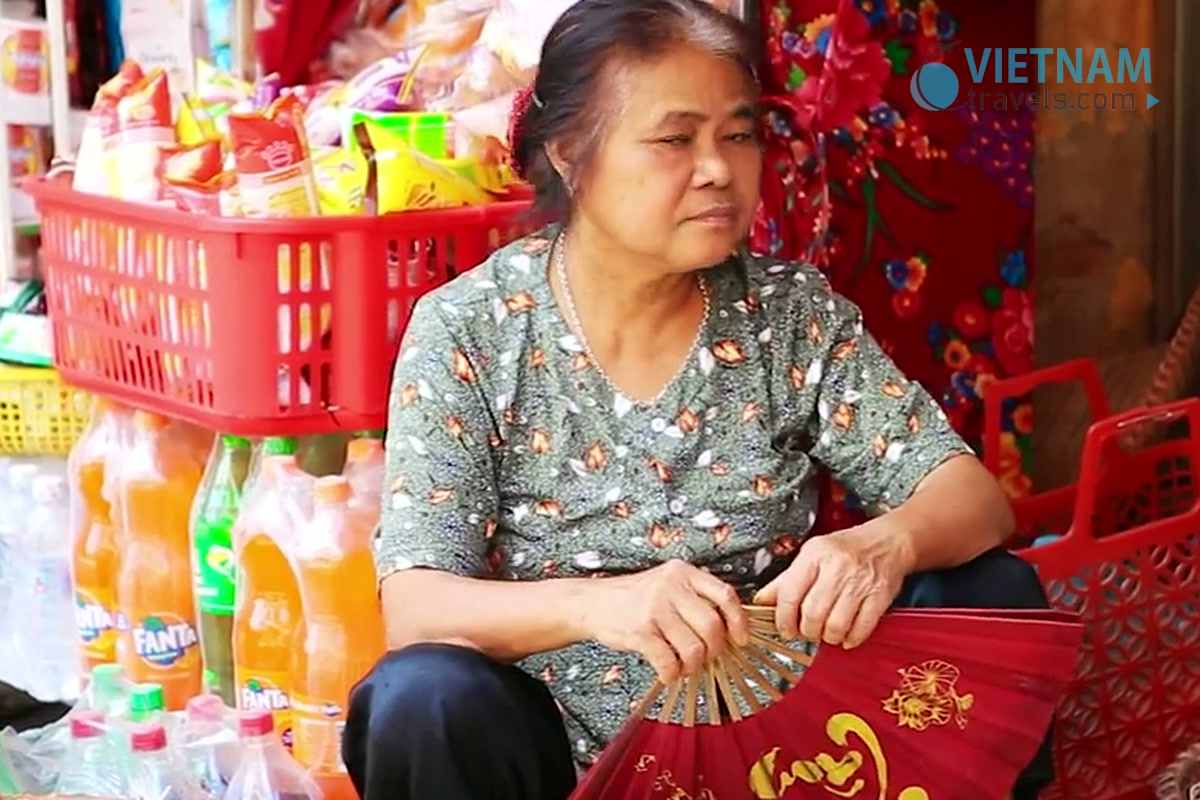
Chàng Sơn’s fan-making tradition forms part of the everyday working life of the village.
Chang Son is worth considering if you enjoy discovering the work behind an ordinary object. You do not need specialist knowledge: comparing an open fan with its folded form immediately gives you questions to ask.
Recent reporting places the village in Tay Phuong commune, Hanoi. Older material commonly uses Chang Son commune and the former Thach That district. For transport, use your host’s current address and map pin rather than relying on an older administrative description.
Planning question
A practical starting point
What is the main interest?
Folding fans, materials, frame construction and decoration
How long should you allow?
Around 1.5–2.5 hours at the destination; longer for a detailed workshop
Should you book?
Yes, for a host, demonstration or practical activity
Is it suitable for families?
Potentially, with appropriate tasks and supervision
Can you buy a fan?
Ask what is available at the chosen workshop
Is there one village-wide schedule?
Arrange access with the individual venue
The suggested duration excludes your journey from Hanoi. It is an itinerary allowance, not a published opening schedule.
A Village Craft That Has Changed with Everyday Life
Fan making and selling connect longstanding village skills with changing customer tastes.
Chang Son has a long-established fan-making tradition within a wider community of crafts, including woodworking. These are related parts of the village’s economic life, but they should not be treated as one occupation.
Hand fans once met a straightforward everyday need for a cooling breeze. Their uses have broadened to include performance, decoration, gifts and souvenirs. A fan designed to move on stage may have different proportions and materials from one intended for a bag or a wall.
The work has also been shared between households. Historical reporting describes producers specializing in particular stages rather than every family completing each object from raw bamboo to packaging.
That helps explain why one workshop may show you assembly while another focuses on decoration or finished products. It does not mean you will see every household making fans during a walk.
The craft is still changing. Recent stories document younger people bringing Chang Son fans to new audiences through digital platforms. An online customer and a village visitor can encounter the same tradition in different ways.
Preservation, in this setting, involves making objects that people continue to use and buy. A new design or a machine-assisted stage does not automatically make a fan less connected to the village’s skills.
What Makes a Chang Son Fan Interesting?
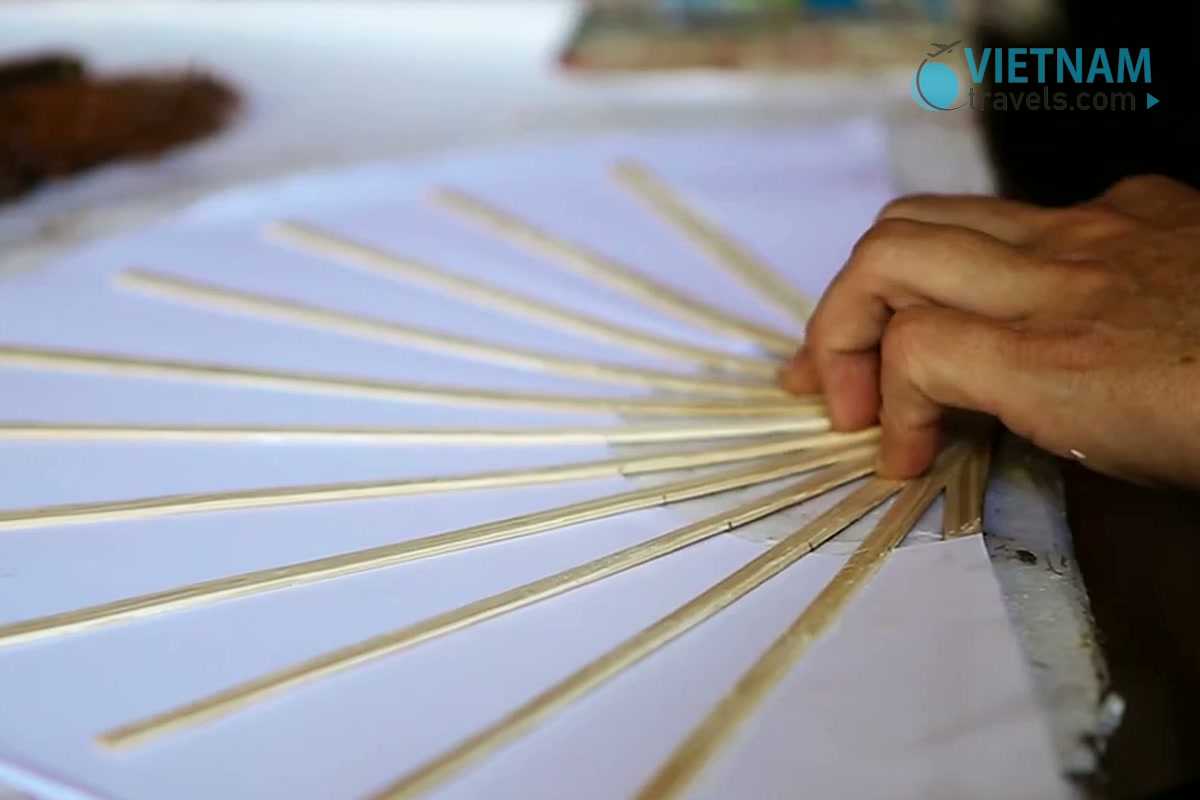
The spacing of the ribs helps determine how a fan opens, folds and supports its surface.
The bamboo frame
The frame gives a folding fan its structure and movement. Slender ribs support the surface, while the outer guards help protect the folded object. Their connection at the pivot allows the fan to open and close.
Compare the spacing when the fan is open. Then ask how the maker adjusts the frame to suit the size and purpose of the piece. A decorative fan can demand a different balance from a small everyday one.
When handling a finished fan, follow the seller’s guidance. Forcing it open tells you less about its quality than watching how it moves under normal use.
Paper, fabric and the folded surface
Chang Son products can use paper and various fabrics. Do paper appears in some ranges, but it should not be assumed to be the material in every fan. Equally, a silk-like surface is not proof of silk.
Ask what you are looking at. The answer helps explain the appearance, care requirements and price.
The surface must work with the frame. Positioning, attachment and folds determine how it spreads and gathers. Looking at those relationships makes the craft more understandable than simply describing a fan as colorful.
Painting, printing and decorative design
Decoration may be hand-painted, printed or produced through another process. A visitor should be able to ask which without implying that only one category has value.
A hand-painted fan carries the work of an artist across a surface broken by folds and ribs. Printed designs can serve other needs, including repeat motifs and larger orders. A visitor-painted fan is different again: it records your participation, rather than automatically becoming a fully handmade artisan piece.
Choose according to what you appreciate, with an accurate description of how the object was made.
How a Traditional Folding Fan Is Made
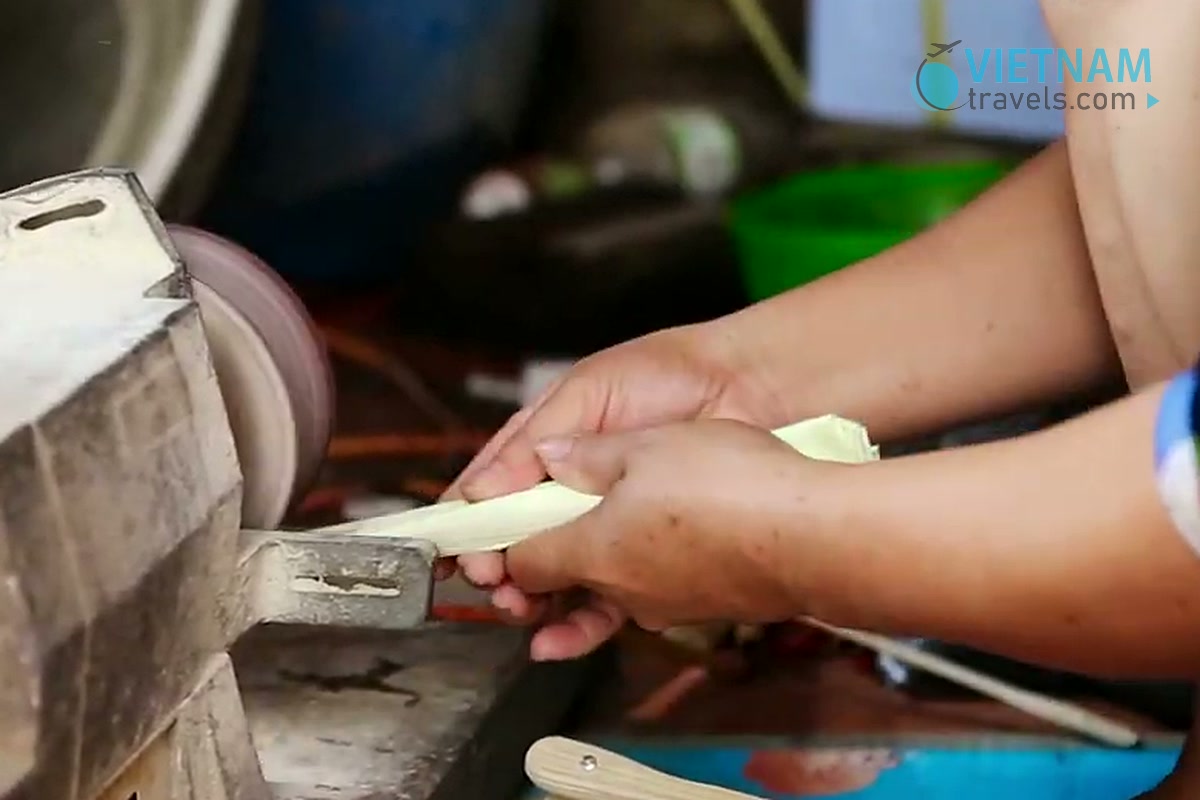
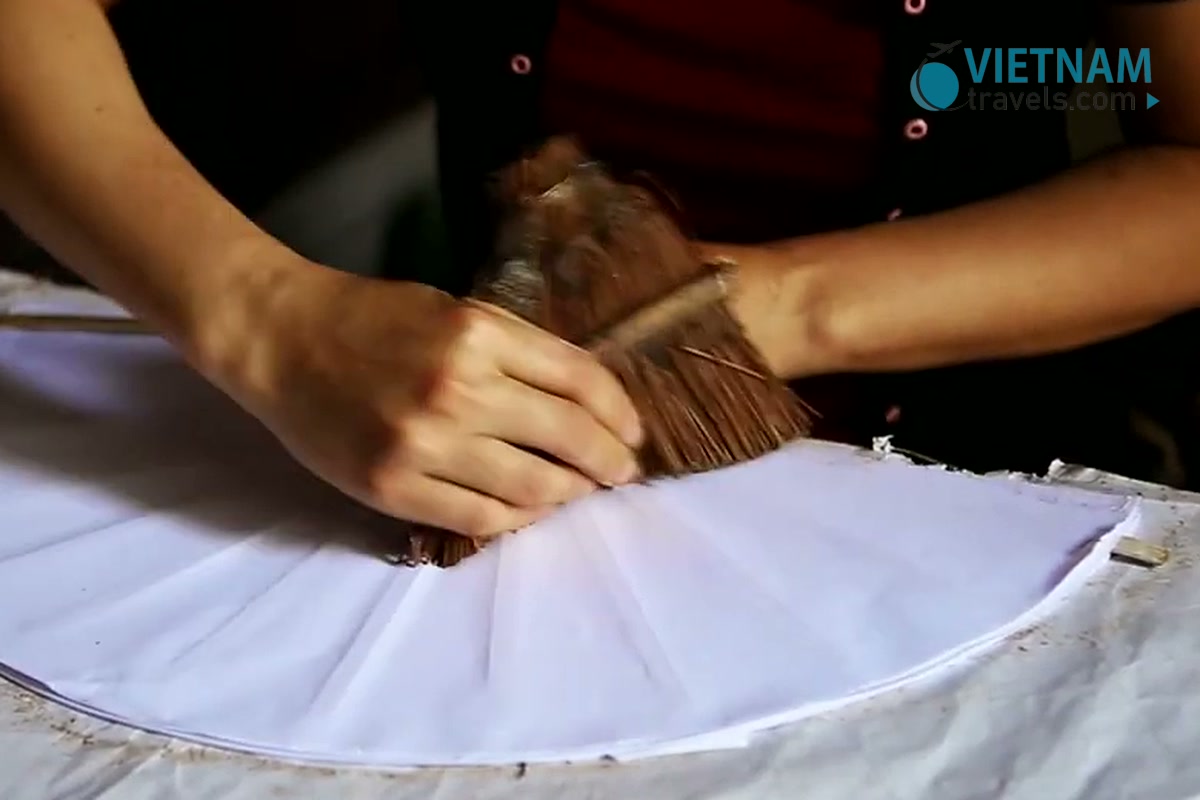
Shaping bamboo components calls for consistent dimensions and careful tool work.
There is more than one production arrangement, and the sequence can vary with materials and design. The following stages provide a framework for understanding what a host demonstrates.
Stage
What to observe
What to ask
Selecting and preparing bamboo
Material quality and readiness for use
What preparation happened before today?
Cutting and shaping ribs
Dimensions, smoothness and consistency
How does the intended fan determine the rib shape?
Joining the frame
Alignment and the pivot connection
How is movement checked?
Preparing the surface
Cutting and positioning paper or fabric
Which material is used, and why?
Attaching and folding
Adhesion, spacing and the folded form
Which steps require the most adjustment?
Decorating and finishing
The image, edges and final opening action
Is the decoration painted, printed or applied another way?
Traditional bamboo preparation can take substantial time before the material reaches the visitor’s table. A short activity therefore usually works with components prepared earlier.
Making consistent ribs and attaching a surface require different skills. At one stage the maker is judging strength and movement; at another, alignment and appearance become central.
Machines may assist with some tasks. The useful question is which decisions and operations remain in the maker’s hands, rather than whether any tool beyond a knife has been used.
For art and design enthusiasts, the folds offer a particularly interesting challenge. A picture must be considered both as an open composition and as part of a moving object. Ask to compare it open and partly closed if the maker is comfortable demonstrating.
Do not expect a complete production cycle to occur for your benefit. Several stages may be taking place elsewhere or may have been completed days before your visit. A clear explanation can connect those stages without pretending that the whole process is immediate.
What Can Visitors Actually Do?
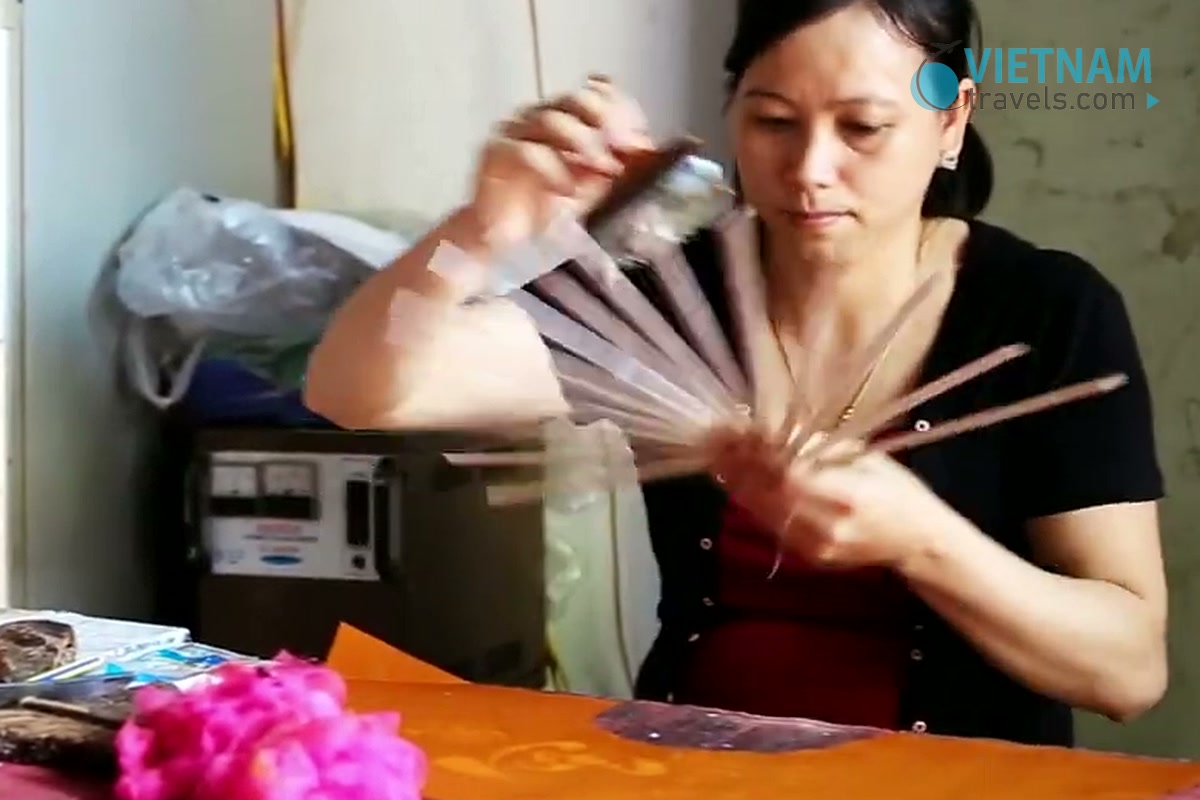
A maker arranges fan ribs, illustrating the skilled work visitors can ask a host to explain.
Observation, demonstration, assembly and decoration are distinct experiences. Agree on the format before booking, especially if your main reason for traveling is to work with the materials yourself.
Watch a working process
An arranged visit can introduce the work taking place that day. A host might explain frame preparation, surface attachment or finishing, depending on the venue and production schedule.
If a particular technique matters, request it in advance. Arriving at a fan shop does not guarantee access to a production area or an artisan available for a long conversation.
An interpreter or knowledgeable guide can make the visit more rewarding. A driver’s presence should not be assumed to include that service.
Join a prepared activity
Published visitor programs demonstrate that fan-related activities can be arranged in Chang Son. These may include assembling prepared components or decorating a fan.
The description should be precise. Painting a completed fan can be enjoyable, but it is not the same as preparing the bamboo frame. An introductory assembly activity also does not reproduce months of material preparation.
Before booking
Confirm
Participation
Which stages will each person undertake?
Components
Are you using prepared ribs, a blank surface or a finished fan?
Language
Who explains the activity, and in which language?
Children
Which tasks are appropriate for their age?
Completion
Does glue or paint need time to dry?
Take-home arrangements
Is the finished item included, and how will it be packed?
Cost
Are materials, instruction and any additional decoration included?
Published tour information distinguishes Vietnamese guiding from English-language arrangements quoted on request. Confirm the language of your own experience rather than expecting the workshop to provide English automatically.
For children, prepared frames and age-appropriate decoration may be more suitable than cutting bamboo. Sharp-tool work belongs with trained adults under the venue’s rules.
Browse and compare finished fans
Shopping can be part of the visit without replacing its explanation. Ask to compare a daily-use fan, a performance piece and a decorative example where available.
There should be no assumption that joining an activity requires extra purchases. A clearly stated activity fee recognizes the host’s materials and teaching time separately from sales.
Planning a Visit from Hanoi
For a visit from Hanoi, agree on the exact pickup location and calculate travel time from your accommodation. (Source: Collected)
Confirm the host before booking transport
Arrange the workshop, contact person, location pin and proposed activity first. Then calculate the journey from your hotel to that exact address.
Distance estimates vary with the starting point and selected venue, so avoid treating a general “distance from Hanoi” as a guaranteed transfer duration. Allow separately for traffic, walking and any additional stop.
Ask whether a vehicle can reach the meeting point directly or whether a short walk is involved. Mention mobility requirements when arranging the visit.
You can fit the excursion within a wider city stay using our Hanoi travel guide. Count the usable time on your chosen day rather than adding a craft visit after a full sightseeing program.
Choose a focused half-day or a fuller day
Option
Suggested structure
When it makes sense
One craft focus
Hanoi, Chang Son visit, optional practical session, return
You want time to understand fan making
Two complementary crafts
Chang Son, lunch, an arranged Thach Xa bamboo-dragonfly visit
Your group enjoys comparing materials and techniques
Craft and heritage
Chang Son plus one suitable cultural stop
You want variety and the timings work
These are planning formats rather than fixed departures.
If the workshop runs longer because the group is interested, that can be a reason to simplify the rest of the day. Protect the main experience instead of cutting it short to maintain an ambitious checklist.
Confirm lunch arrangements in advance. A working household or studio is not automatically a restaurant, even when it receives visitors.
Let working conditions shape the day
Outdoor drying and walking can be affected by weather. An indoor demonstration may still work, but access and activities need confirming with the host.
Holiday periods can also change staffing or opening arrangements. Ask about your actual date, including around Tet, rather than assuming there is a fixed year-round program.
Photographs of colorful fans drying outdoors describe one moment in production. They are not a promise that every visit will produce the same scene.
What to Combine with Chang Son
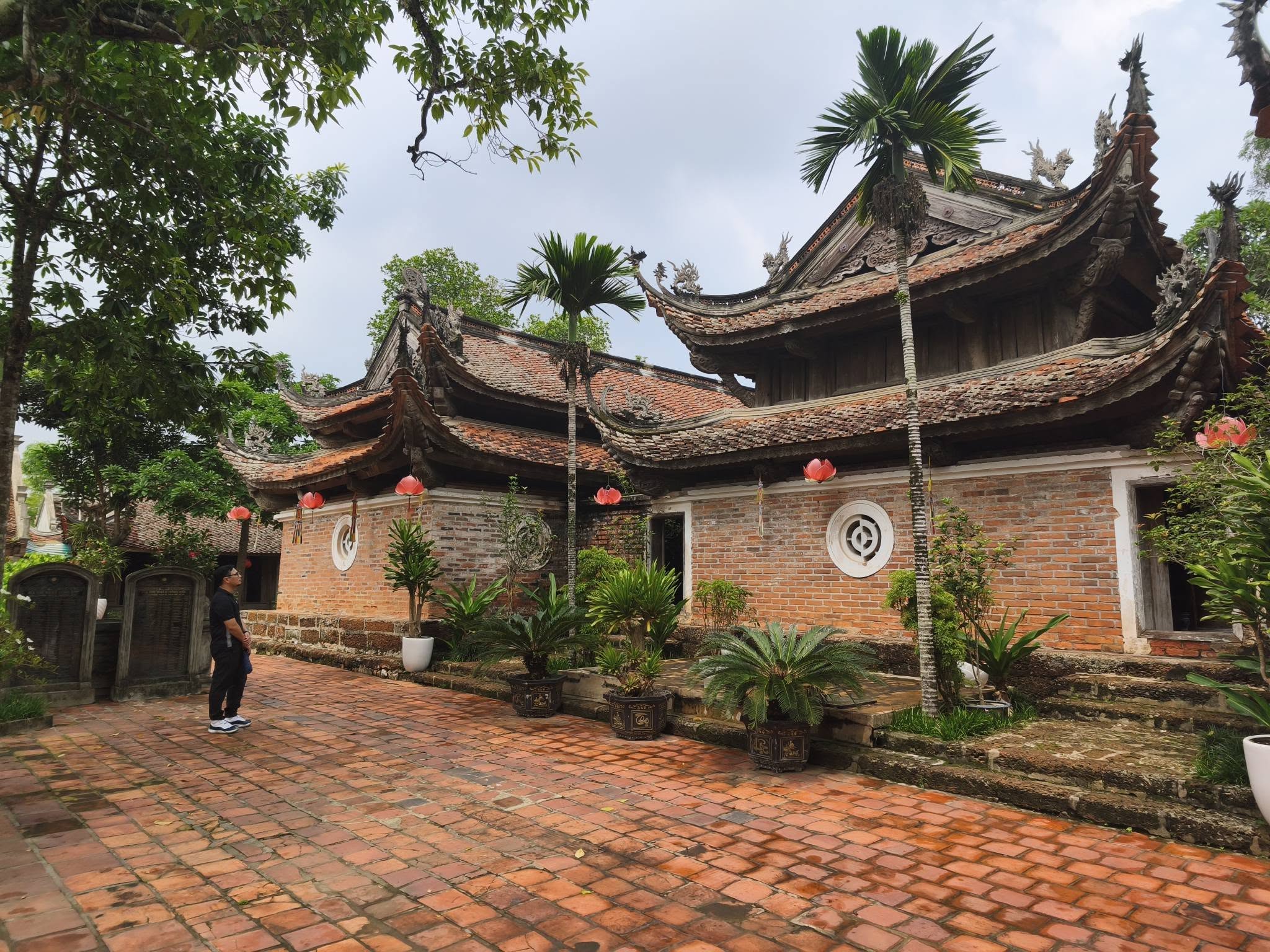
Tay Phuong Pagoda is one possible cultural stop to consider alongside Chàng Sơn when timings and access suit the group. (Source: Collected)
Thach Xa bamboo dragonflies
A bamboo-dragonfly visit provides a useful comparison: the material may be familiar, but the craft problem changes from a folding structure to an object designed to balance.
This combination appears in published visitor programs, making it a practical format to investigate. Still, book the actual activity and clarify whether guests observe, assemble, decorate or try a balancing exercise.
Do not promise children access to knives simply because cutting is part of professional production.
Tay Phuong Pagoda
A pagoda visit offers a change from the workshop and a different cultural focus. Check opening arrangements, the route and the steps involved before adding it, particularly for anyone with mobility limitations.
Allow time to dress appropriately, visit respectfully and return without rushing. If the group mainly wants a practical workshop, a second craft activity or an unhurried return may suit better.
More stops do not automatically make the day better. Choose one addition that strengthens the visit rather than trying to include several western Hanoi destinations at once.
Buying a Fan and Visiting Thoughtfully
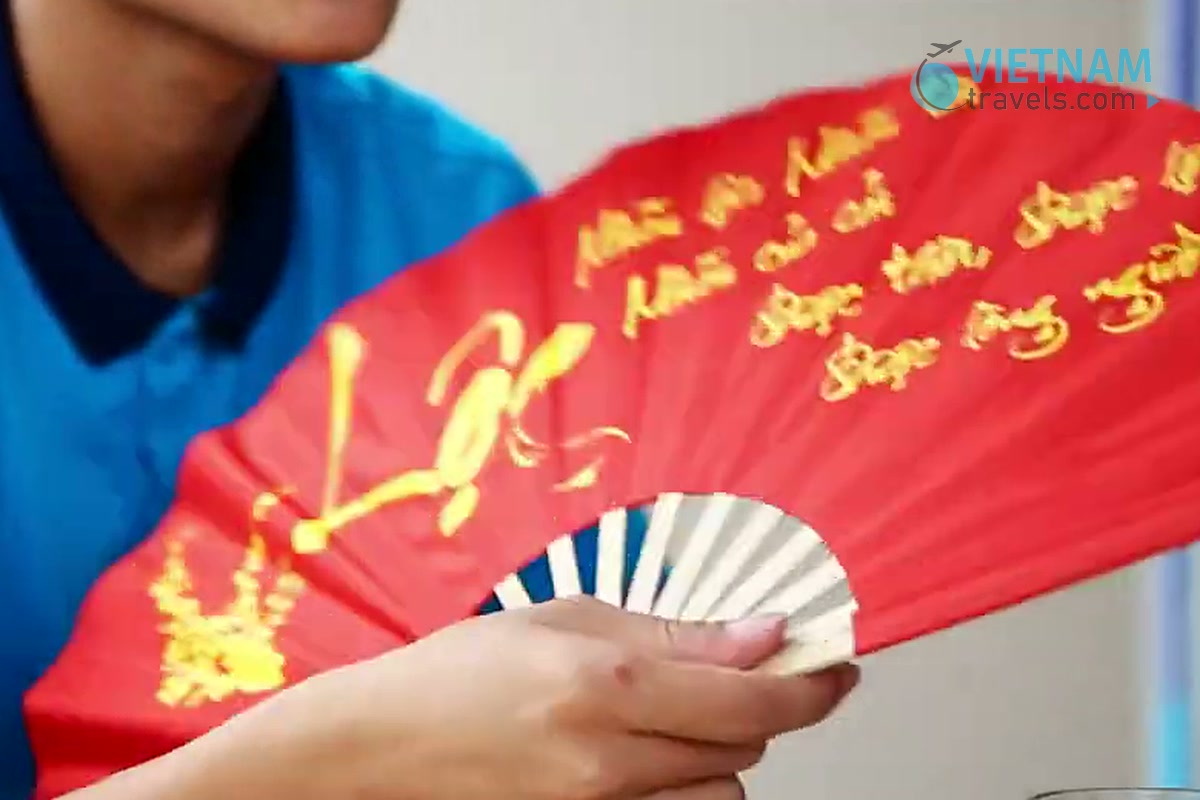
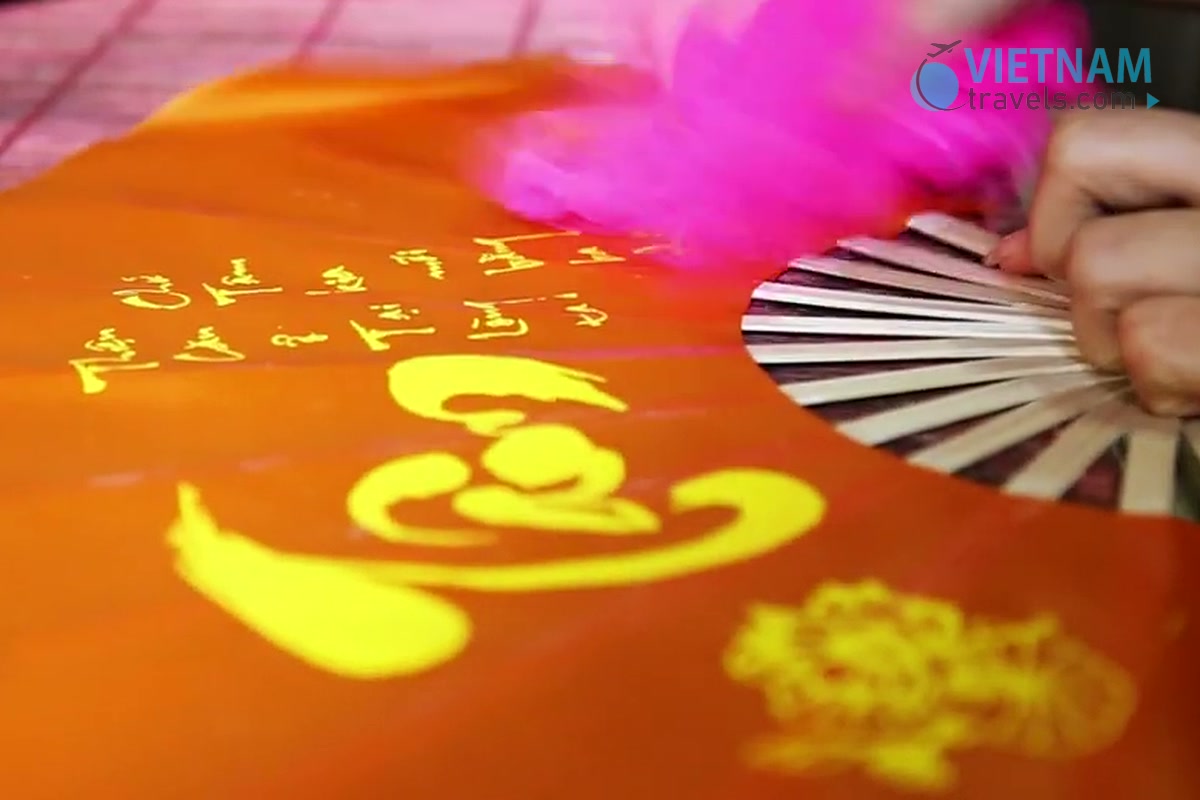
A decorated fan combines a folding structure with colour, lettering and finishing details.
Begin by asking what the fan is intended to do. An everyday hand fan, a performance accessory and a large wall decoration should be judged against different needs.
Then clarify the material and decorative method. A convincing description is more useful than assuming that an old-fashioned appearance proves a particular age or technique.
Ask the seller to demonstrate normal opening and closing. Check the size both open and folded, especially for a decorative purchase that must travel home.
Paper and fabric need care. Request suitable packing and advice about moisture, cleaning and storage. If you decorate a fan yourself, ask when it is dry enough to fold and pack.
Inside a workspace, keep bags away from drying products and tools. Do not move fans into the light for a photograph or handle unfinished work without permission.
Ask before photographing people, especially in household spaces. A working village is also a place where people live, and access to a studio is not an invitation into every adjoining room.
Finally, avoid assuming that bamboo and paper make every product entirely environmentally benign. Adhesives, dyes, finishes, sourcing and production all matter. Appreciate the material and skill without attaching claims the maker has not substantiated.
Frequently Asked Questions
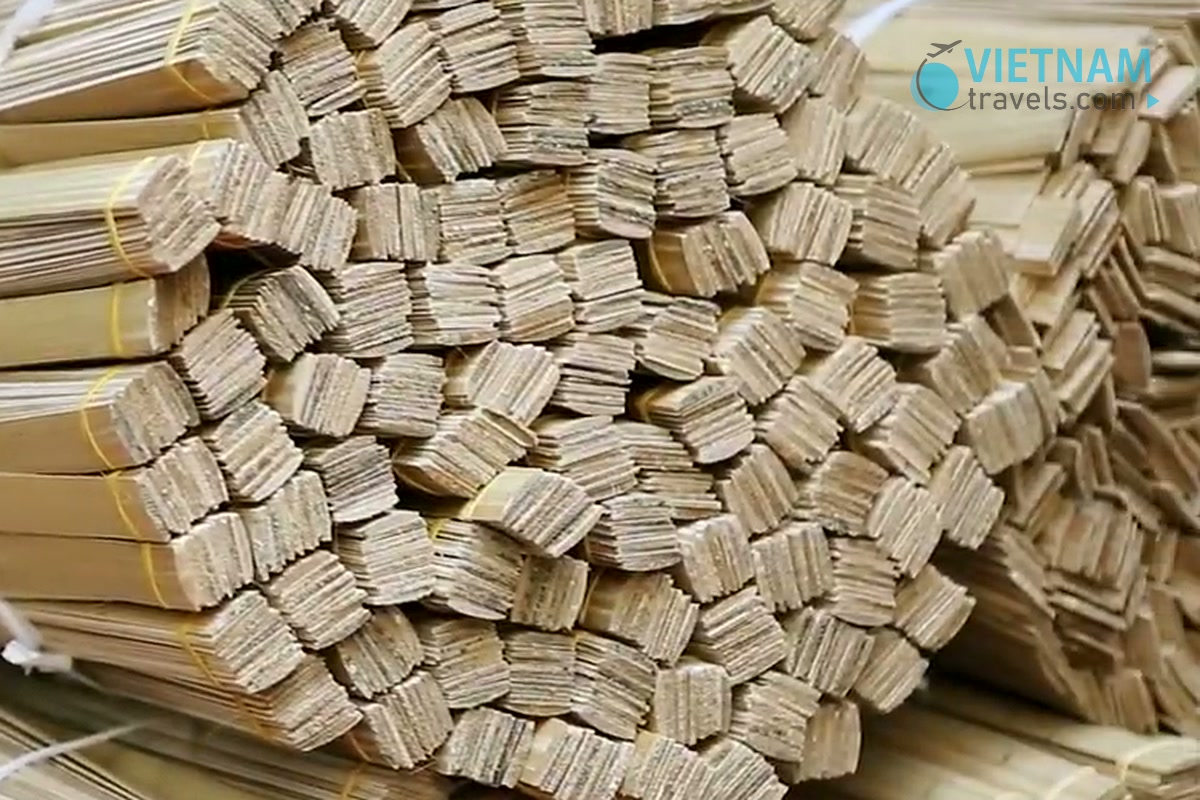
Prepared bamboo components are one part of a longer process; ask which stages a booked activity includes.
Is Chang Son suitable for a day trip from Hanoi?
Yes. A focused visit can form part of a half-day or longer excursion, depending on your hotel, traffic and activity. Confirm the venue before arranging transport.
Can visitors make their own fan?
Prepared activities may be arranged, but the content varies. Ask whether you will assemble components, attach the surface or decorate a completed fan.
Are all Chang Son fans handmade and hand-painted?
Do not assume so. Handwork, printed decoration and machine-assisted stages can coexist. Ask about the particular piece you are considering.
Is the experience suitable for children?
It can be when the venue provides age-appropriate tasks and adult supervision. Decorating prepared components is different from working with sharp bamboo-cutting tools.
Can I take the finished fan home the same day?
Possibly, depending on the activity and drying requirements. Confirm this beforehand, particularly if you travel onward that afternoon.
Should I combine Chang Son with Thach Xa?
It is a worthwhile option for a group interested in two different crafts. Leave enough time for both, and make sure the programs offer the participation you want.
Plan Your Chang Son Craft Village Visit
Working on the frame and its surface reveals the decisions behind a finished folding fan.
Choose the encounter first: watching a maker work, understanding a folding structure, trying an activity or selecting a fan for your home.
A modest object can reveal a great deal when someone explains the choices behind it. Give that conversation room in the day, and the fan you bring back will have more meaning than its pattern alone.
Contact us to discuss a Chang Son craft village visit. Share your date, group size, children’s ages where relevant and preferred activity. We can help investigate a suitable host and confirm the language, workshop content and travel arrangements.
Our trips to Vietnam packages collection can help you connect a craft village visit with a wider journey.
Sources and References
Information reviewed on 28 November 2026. Older reporting supports craft history and technique; it is not treated as a current census, opening schedule or confirmation that every household follows the same process. Individual visitor arrangements require reconfirmation.